Services-Led FDI: The Missing Link in Accelerating National Economic Strategy
Services-Led FDI: The Missing Link in Accelerating National Economic Strategy
Why governments should actively support execution platforms that bring global innovation into local capability. An opinion article by Dr. Anjo De Heus, 360Disruption.
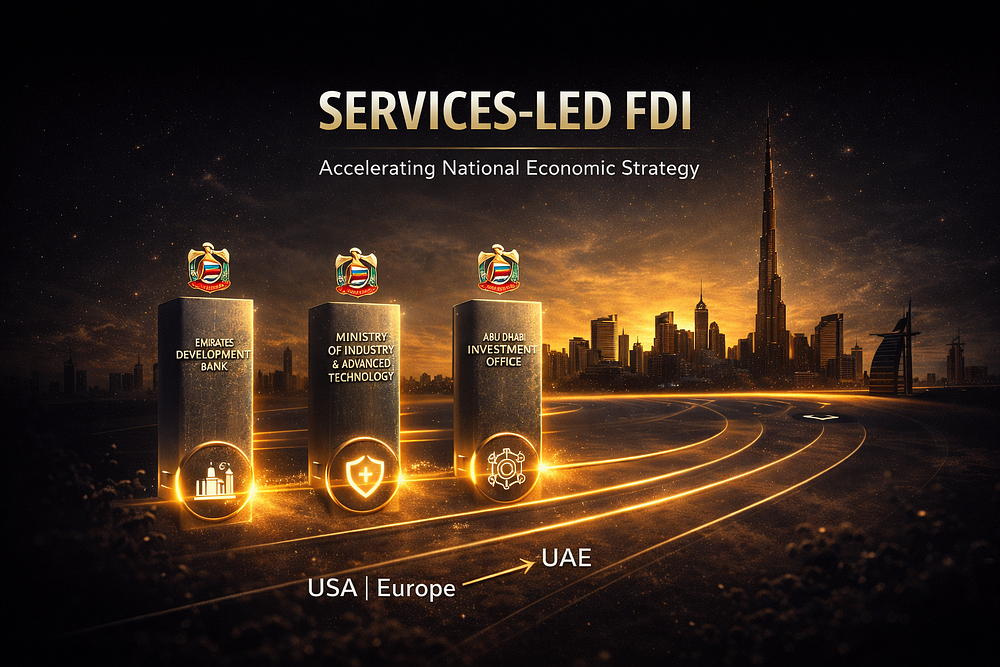
For decades, foreign direct investment (FDI) has been measured in factories built, capital deployed, and infrastructure developed.
But the world has changed.
The next wave of economic growth will not be driven by infrastructure alone —
it will be driven by speed, adaptability, and the ability to translate global innovation into local execution.
This is where services-led FDI emerges as a critical, and often overlooked, component of national economic strategy.
Beyond Traditional FDI
Traditional FDI plays an essential role in building long-term industrial capacity.
However, it is inherently slow:
- long development cycles
- high capital intensity
- delayed economic impact
In contrast, services-led FDI introduces a fundamentally different model:
bringing market-ready companies and solutions into an ecosystem, enabling immediate deployment, and creating value from day one.
It is not a replacement for industrial investment —
it is an accelerator of it.
From Attraction to Activation
Governments across the Gulf, particularly the UAE, are no longer focused solely on attracting companies.
They are focused on activating ecosystems.
This means:
- enabling companies to enter efficiently
- supporting them to localize operations
- ensuring alignment with national frameworks such as ICV
- and creating pathways for regional expansion
This shift requires a different type of partner.
Not consultants.
Not intermediaries.
But execution platforms.
What Services-Led FDI Looks Like in Practice
At 360Disruption, this model is already being activated.
Through structured international corridors — including the United States and Southeast Europe via REDI and the Balkan Impact Network — a pipeline of execution-ready healthcare and innovation solutions is being positioned for the UAE.
This includes:
- Oasis Diagnostics — non-invasive saliva-based diagnostic technologies with clear pathways toward UAE-based localization and manufacturing
- MedScribe AI — Arabic-first clinical AI enabling multilingual healthcare workflows across the region
- MedBridge — digital healthcare connectivity platform linking patients, specialists, and providers
- Oludent Health — preventive oral health ecosystem combining tele-dentistry, school screening, and AI diagnostics
These are not early-stage concepts.
They are proven, deployable solutions aligned with:
- local value creation
- workforce development
- industrial localization pathways
- and regional scalability
This is what services-led FDI looks like when it moves from theory to execution.
Why Governments Should Pay Attention
Supporting services-led FDI platforms is not about backing individual companies.
It is about enabling a systematic pipeline of innovation inflow.
For institutions such as ministries of industry, development banks, and investment offices, the advantages are clear:
1. Immediate Economic Impact
Unlike traditional projects, services-led FDI generates activity within months, not years.
2. Accelerated ICV Contribution
Local operations, workforce engagement, and service delivery contribute to national value frameworks from day one.
3. Lower Risk Profile
These are validated solutions with existing use cases, reducing execution risk.
4. Continuous Deal Flow
Through international corridors, governments gain access to a structured pipeline, not isolated opportunities.
5. Strategic Sector Acceleration
Priority sectors such as healthcare, AI, and digital infrastructure can be advanced rapidly through targeted inflow.
From Opportunity to Strategy
If governments are serious about accelerating economic diversification and innovation-driven growth, then services-led FDI must become part of the strategy.
One logical step would be the creation of dedicated development or co-investment vehicles designed to:
- support market entry and localization
- co-invest in scalable solutions
- reduce barriers for foreign companies
- and accelerate ecosystem formation
Rather than waiting for companies to arrive, governments can:
actively pull innovation into their economies
The UAE’s Unique Position
The UAE is uniquely positioned to lead this model.
With strong institutional frameworks, a pro-business environment, and strategic geographic positioning, it can act as:
a global hub where innovation lands, localizes, and scales across the GCC, Africa, and beyond.
But capturing this opportunity requires more than policy.
It requires execution infrastructure.
Conclusion
The future of FDI is not just about capital.
It is about capability.
It is about how quickly a nation can take global innovation and turn it into local value, jobs, and economic impact.
Services-led FDI is not a trend.
It is a necessary evolution.
And those who embrace it early will define the next generation of economic leadership.
Closing Line
From global innovation to national impact — this is where execution matters most.
About the Author
Dr. Anjo De Heus, DBA is the founder of 360Disruption, a UAE-based execution platform focused on services-led foreign direct investment, health innovation, and industrial localization.
He operates at the intersection of global innovation and national economic strategy, building structured pathways for international companies to enter, localize, and scale within the UAE and across the GCC and Africa.
Through strategic corridors connecting the United States and Southeast Europe — including collaborations with the REDI Balkan Impact Network — he actively brings market-ready healthcare, AI, and diagnostic solutions into the region, aligning them with In-Country Value (ICV), workforce development, and industrial growth priorities.
His work centers on transforming foreign direct investment from isolated transactions into continuous, execution-driven pipelines of innovation, contributing to the UAE’s ambition to become a global hub for advanced industries and healthcare innovation.
Dr. De Heus brings decades of experience in venture building, cross-border commercialization, and strategic partnerships, and is a strong advocate for services-led FDI as a catalyst for faster, more agile economic development.


Comments
Post a Comment